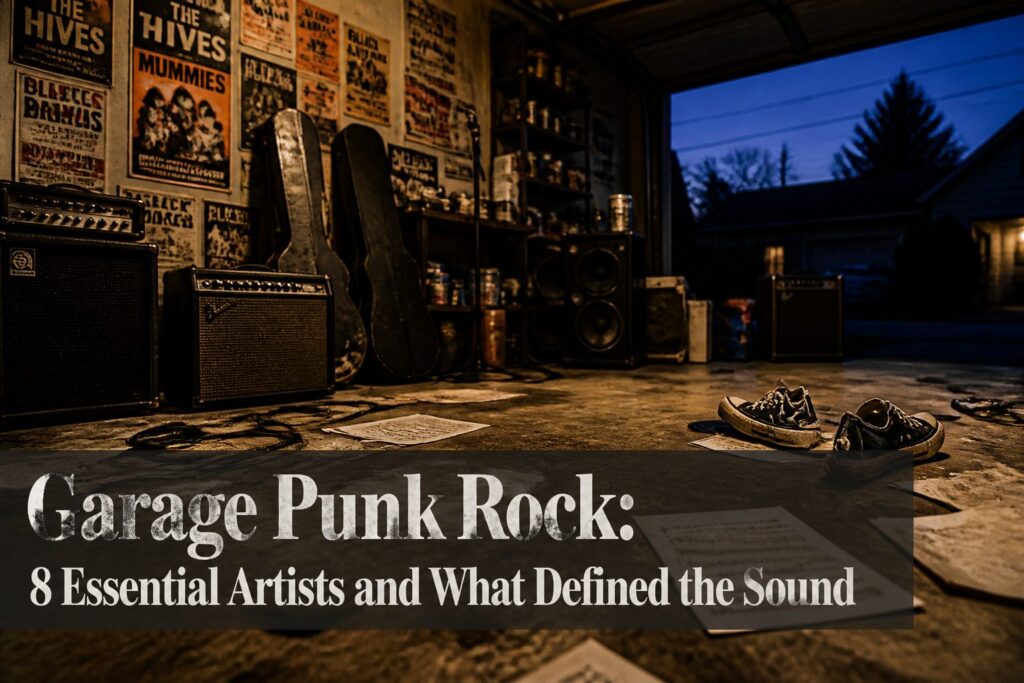
Garage punk rock is the sound of teenagers with broken amps and no money deciding that the distortion was the point, not the problem.
The genre fused 1960s garage rock’s primal urgency with punk’s speed in early-1980s American suburbs, built on the understanding that polish was not just unaffordable but actively unwanted.
The Hives proved it could scale without softening; The Mummies played in full mummy costumes through amps pushed past clipping.
[link-whisper-related-posts]What Garage Punk Rock Is
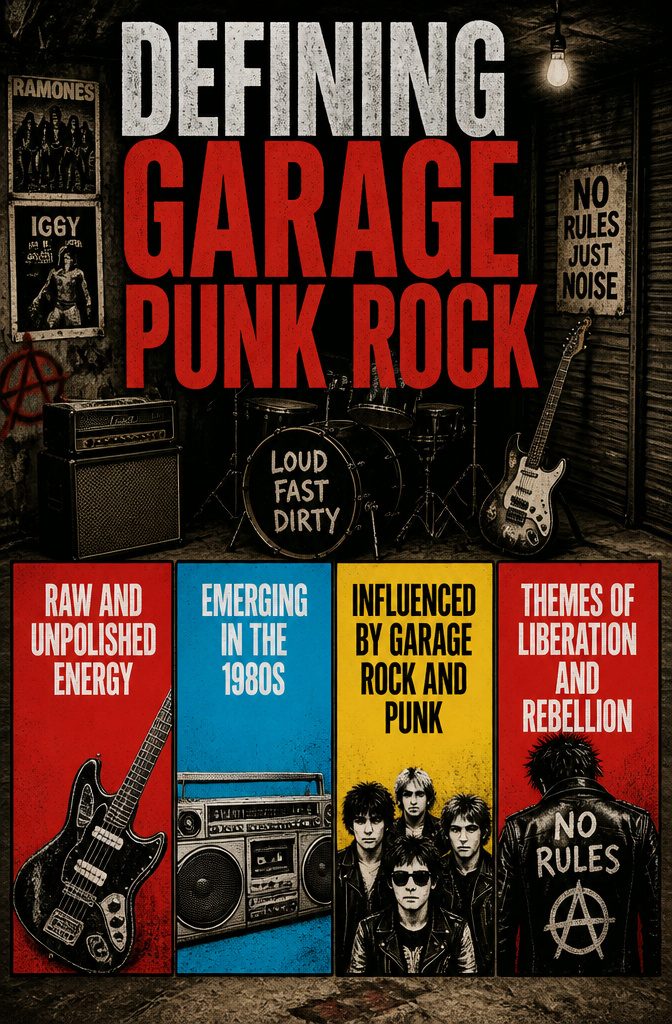
Garage punk rock fuses the raw, unpolished energy of garage rock with the speed and aggression of punk, and it emerged in the United States at the start of the 1980s.
The sound is built on fast tempos, lo-fi production, and guitars that cut sharp and brittle. Lyrically, it gravitates toward sex, drugs, partying, and an antisocial stance that reads as liberation from social rules rather than mere rebellion.
The genre’s roots run in two directions. One path leads back to the late 1960s, when American garage bands tried to copy British rhythm and blues groups and ended up with something rougher and more primal than their models.
The other path connects to the punk movement of the late 1970s and early 1980s. Both threads fed into what became garage punk: the teenage urgency, the working-class suburbs, the sense that polish was not just unaffordable but undesirable.

【Great Clarity and Definition】:It is the same even if the pedal is set under a higher gain level. Just tell the truth that most of the high gain pedals will kill a lot of definition during your plays, but the VSN Heavy Metal Distortion Pedal will never do that! So This should be a main selling points! Especially for these leading guitarists.

[High-Gain Distortion]: As a High-Gain distortion pedal, Donner's Morpher sounds like a crossover between MI Crunch Box and Suhr Riot; Great for hair metal/glam metal/pop metal

CLASSIC ROCK TO HEAVY METAL IN ONE BOX: Dial in everything from a subtle, bluesy crunch to thick, aggressive, high-gain distortion perfect for modern metal. This pedal's wide gain range covers decades of iconic tones, all in one rugged unit.
The People Who Made It
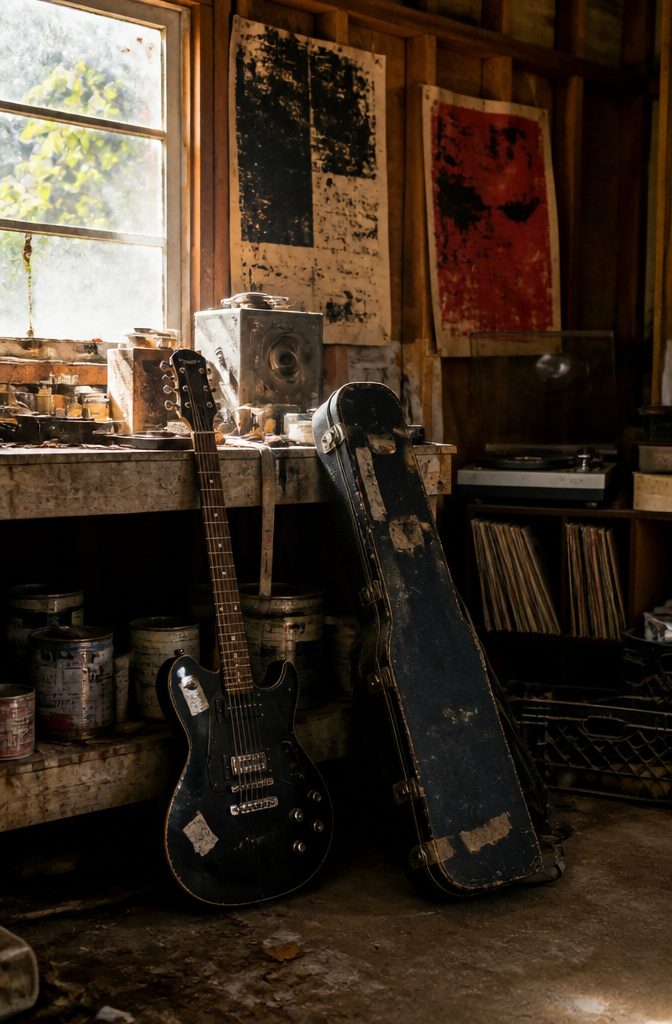
The kids who built garage punk rock were almost always young, white, and working-class, usually living in suburbs where nothing happened and everything cost too much to get to. That boredom was the fuel.
Without money for proper studios or gear that worked right, they leaned into the noise. Feedback became a feature, not a mistake, because fixing it meant spending cash nobody had.
This demographic shaped the sound’s whole attitude.
The suburbs gave them space to practice loud and parents who mostly just wanted the noise out of the garage. The working-class part meant no safety net for failure, which made the whole thing low-stakes by necessity.
You started a band because college or a career track wasn’t waiting, and you stayed independent because major labels weren’t calling towns like that anyway.
The whiteness of the scene is harder to ignore once you look at who got documented and who got left out.
The canon that formed around garage punk rock mostly preserved the bands who fit this narrow profile, even though the music’s raw, anyone-can-do-it framework should have opened wider doors than it did.

Recreate the whole variety of famous fuzz tones of the '60s and '70s
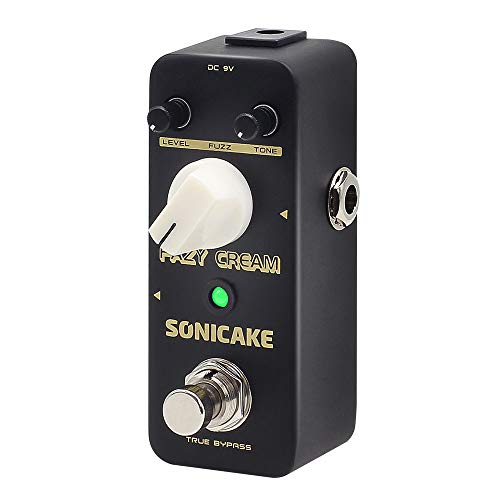
100% Analog Circuit Design: This guitar pedal makes you from classic creamy fuzz to high gain fuzzy distortion with pure analog signal processing

Classic silicon fuzz pedal:Ultra Fuzz Si is a Legendary fuzz pedal designed to recreate the classic fuzz JMI-H style Sound.
The Hives
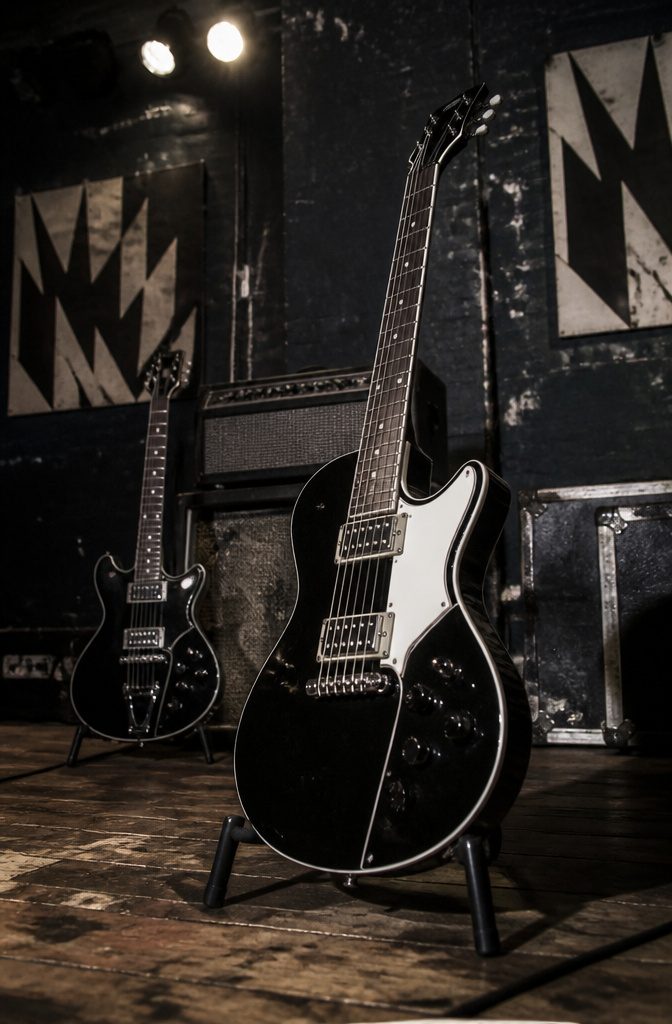
The Hives arrived in the late 1990s with a sound so tightly wound it felt like someone had compressed the entire history of garage punk into a single spring.
Their Swedish origins surprised listeners who assumed that level of sneering, suit-clad precision could only come from Detroit or New York.
Frontman Howlin’ Pelle Almqvist’s onstage contortions and the band’s matching black-and-white wardrobe gave them a visual identity that separated them from the thrift-store aesthetic dominating the scene.
Musically, they stripped rock down to its most compulsive elements: staccato guitar riffs, drums that hit like a slammed door, and songs rarely stretching past three minutes.
"Hate to Say I Told You So" remains the gateway track, a two-and-a-half-minute lesson in how restraint can generate more tension than noise.
Where contemporaries buried hooks under distortion, The Hives placed theirs front and center, almost taunting the listener with their accessibility.
Their significance to garage punk rock lies in proving the genre could scale without softening. Major labels came calling, festivals booked them, and the songs stayed lean and mean.
For anyone building a playlist, they bridge the gap between the raw basement recordings that founded the genre and the sharper production values that let it survive past the 1990s.

Pure Analog Technology for Crystal-Clear Sound: Featuring full analog technology with a precise frequency response of 100Hz-20kHz @ ±3dB, delivering exceptional clarity and natural tone. With 10W high power output, it covers over 165ft, making it perfect for home practice, travel playing, street improvisation

The Fender Frontman 10G Guitar Amplifier features 10 watts, 7.5Hx11.5Wx13.7D inches, 11.7 pounds

This distressed woodblock print style design shows a bold black cat silhouette holding an electric guitar, framed by a rough hand painted border on a soft vintage background. A fun pick for musicians, rock fans and cat lovers with a grunge punk vibe.
Yeah Yeah Yeahs
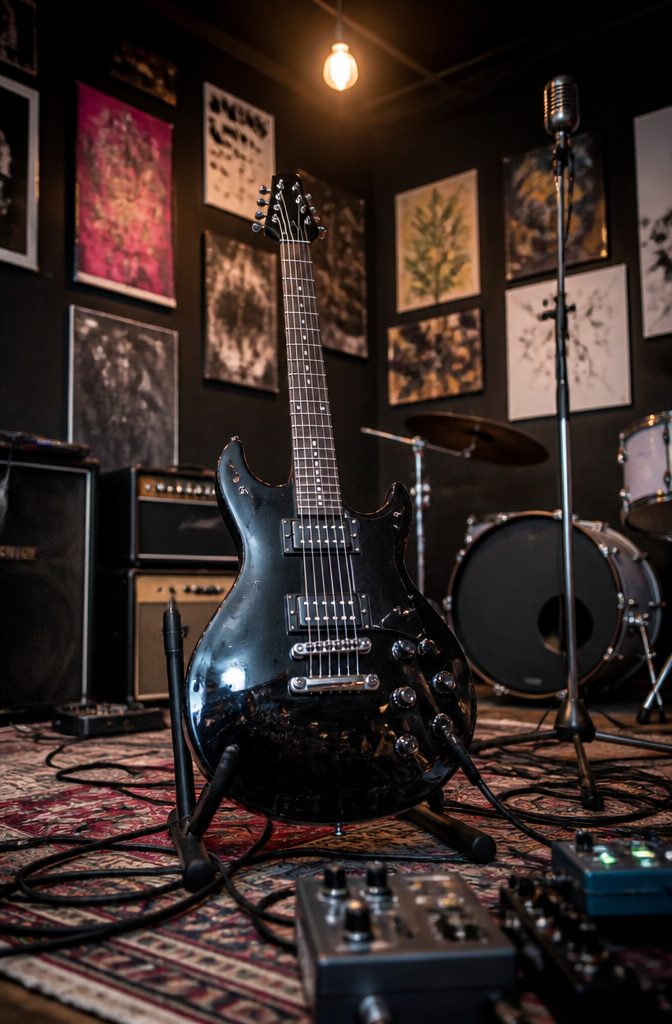
Yeah Yeah Yeahs arrived in the early 2000s with a sound that took garage punk’s raw voltage and ran it through art-school wiring.
Karen O’s vocals shredded without ever settling into conventional punk snarl; she yelped, whispered, and howled like someone who had studied the Stooges but decided stage presence mattered as much as distortion.
The band stretched garage punk’s boundaries by making space for electronics and slower tempos without cleaning up the mess.
"Maps" proved they could hold a melody without sacrificing the danger, while tracks like "Date with the Night" kept the two-minute burst alive.
Brian Chase’s drumming stayed tight and minimal, more Meg White than Keith Moon, which left room for Nick Zinner’s guitar to alternate between brittle chunks and noise washes.
Their cultural impact came from proving garage punk could dress up without selling out. Karen O’s thrift-store outfits and deliberate theatrics made the genre visible to audiences who might have missed the stripped-down revival happening in basements.
The Yeah Yeah Yeahs didn’t replace those origins; they built a bridge between them and the mainstream without demanding listeners choose sides.
【Amazing Multi-effects】Upgraded 3-IN-1 Nebula & Laser & LED disco dance lights for parties, capable of producing 90 combinations of images, 7 color LED backgrounds (red, green, blue, red & green, red & blue, blue & green,red & blue & green) and 2 beam lazer combinations (green, red), creating a more wonderful stage flash atmosphere with multi-effect and high definition projection quality combination

REMOTE CONTROL MODE - You can by the remote to control 100W LED strobe light, you can set white color, enjoy the flickering surprise brought by remote control

REMOTE CONTROL MODE - You can by the 16 keys remote to control 100 watt LED strobe light, you can set red, green, blue, purper, which you like, enjoy the flickering surprise brought by remote control
Thee Milkshakes and Guitar Wolf
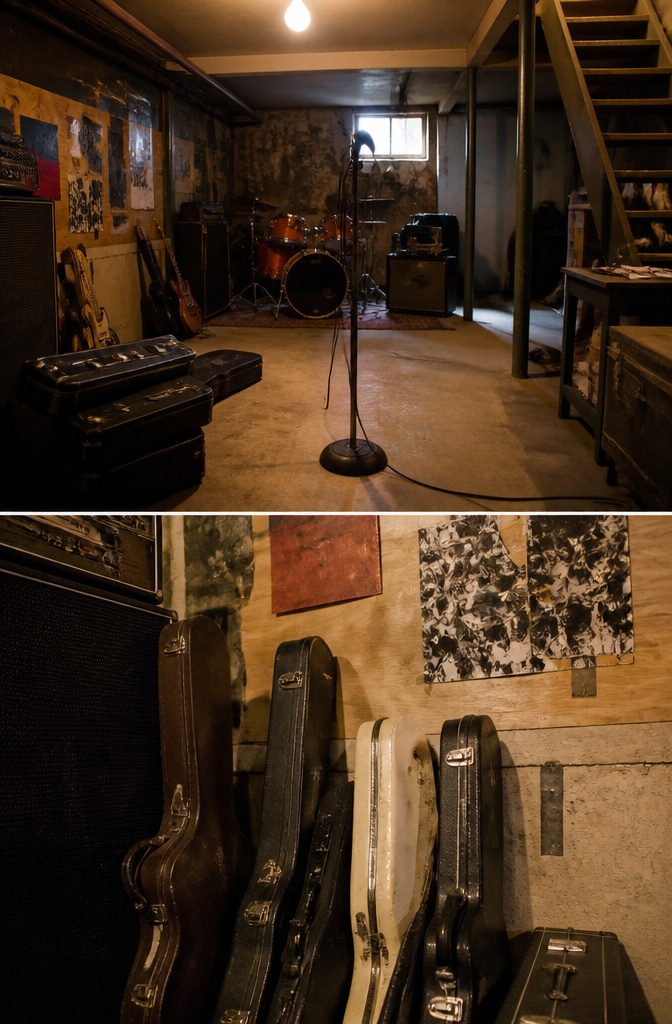
Thee Milkshakes carried British garage punk through the early 1980s with a sound that felt like it had been recorded in a shed and liked it that way.
Billy Childish’s guitar work on their records refused to clean up, keeping the treble sharp and the rhythms just loose enough to sound alive rather than rehearsed.
Their albums came fast, sometimes two a year, and the speed of release matched the speed of the songs: no time to polish meant no time to flatten the energy.
Guitar Wolf arrived from Japan in the late 1980s and pushed the same rawness further into the red.
Their live shows ran on feedback and endurance, with Seiji’s guitar tone set to damage and the rhythm section fighting to keep up rather than hold back.
Where Thee Milkshakes kept one foot in 1960s R&B structure, Guitar Wolf stripped even that away, reaching for something closer to pure forward motion.
Both bands proved garage punk traveled without translation; the distortion and urgency read the same in Tokyo or Chatham.

【Extreme Metal Tone】 Extreme metal distortion pedal is designed for metal & hard rock guitarists.

Distortion Is Therapy artwork featuring a distressed guitar effects pedal with a rebellious face, audio cables and bold punk rock lettering.
Mod Fun and The Gories
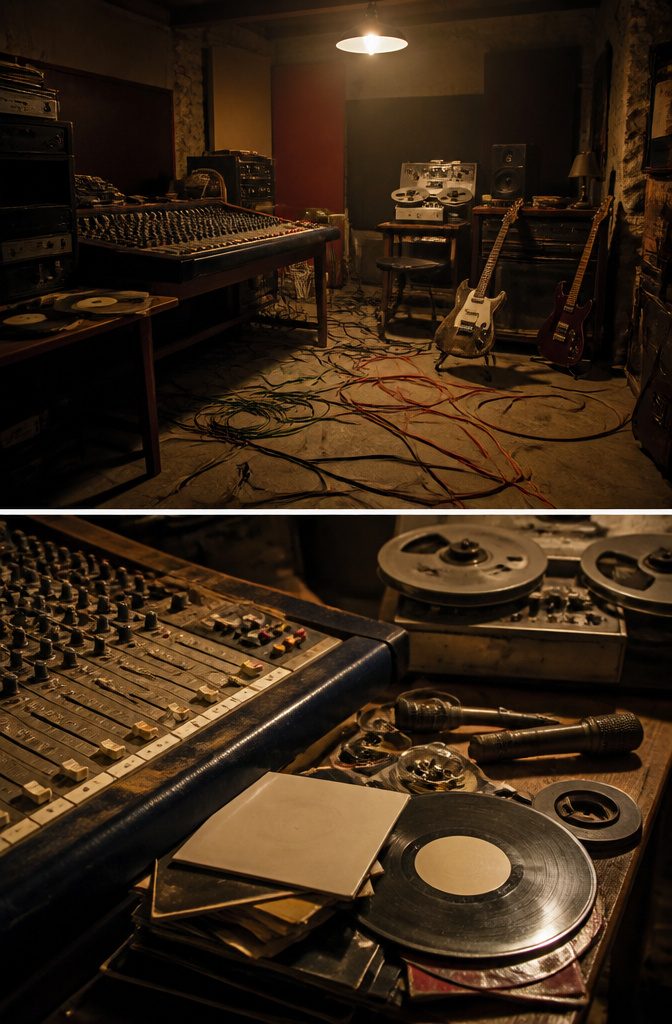
The 1980s garage punk rock revival needed bands willing to sound worse on purpose. Mod Fun and The Gories both built their reputations on that bet.
Mod Fun came out of New Jersey with a sound that ignored the decade’s production trends entirely.
Where mainstream rock was stacking synthesizers and gated reverb, they recorded guitars that buzzed like broken radios and drums that sat right up against the microphone.
The songs themselves pulled from 1960s British Invasion hooks, then played them through equipment that would have embarrassed a wedding band. That tension, between polished songwriting and deliberately raw execution, became a template other revivalists followed.
The Gories took the lo-fi commitment further. Formed in Detroit, the trio operated with a technical limitations-as-virtue philosophy: cheap guitars, minimal drum kits, and recording setups that captured room noise as prominently as the instruments.
Their rhythm section often sounded on the verge of collapse, which was exactly the point. The Gories proved that garage punk rock didn’t need fidelity to deliver impact; it needed momentum and the nerve to let mistakes stand.
Both bands treated the 1960s garage tradition less as museum piece than as unfinished business. They weren’t covering Nuggets compilations; they were arguing that the original punks had stopped too soon.

Behringer FUZZ BENDER Guitar Effects Pedal for Distortion and Fuzz

【Vintage to Modern Fuzz】From warm vintage saturation to cutting modern distortion, EMBARK 07 FUZZ delivers a wide tonal range while maintaining clear note definition and rich harmonics.

Legendary Fuzz Tone: Dynamic, full, and sweet-sounding fuzz effect for authentic vintage vibe.
The Mummies and Oblivians
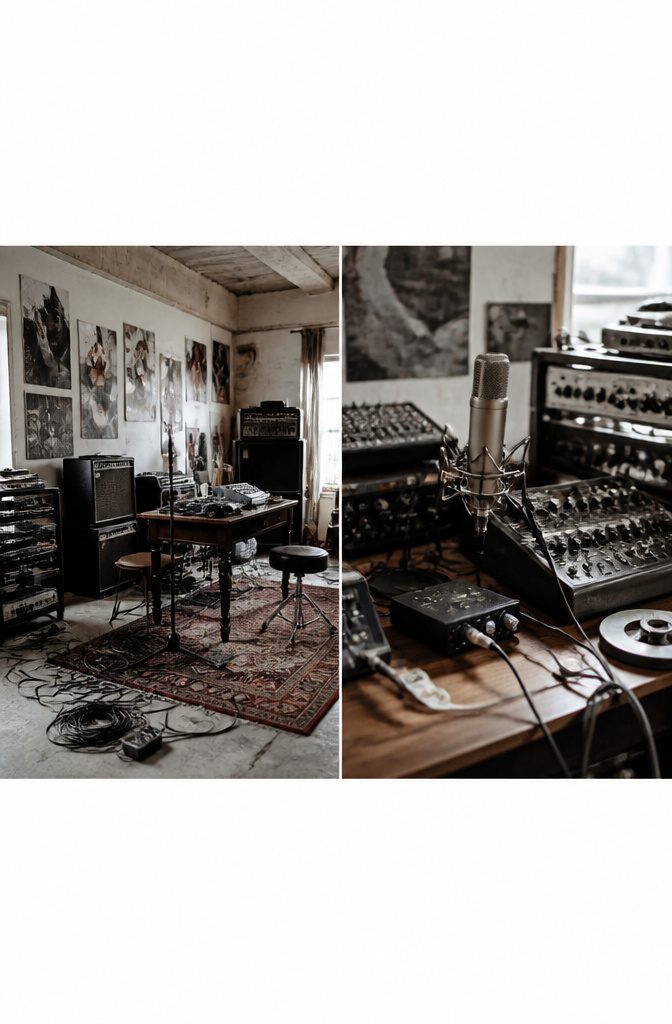
The Mummies and Oblivians took the lo-fi ethos of garage punk rock and pushed it into deliberate self-sabotage.
The Mummies, out of San Bruno, California, played in full mummy costumes through blown-out amps and refused to release albums on CD for years, treating any polish as betrayal.
Their records sound like they were taped on a boombox in a concrete room, which was close to the truth.
Greg Cartwright, first with the Oblivians in Memphis and later with Reigning Sound, came from the same impulse: songs recorded fast, with one microphone catching everything bleeding together.
This anti-production became its own production style. Where mainstream rock chased separation and sheen, these bands proved that clipping and distortion could be the point, not the mistake.
The Mummies’ 1992 LP Never Been Caught and the Oblivians’ …Play 9 Songs with Mr. Quintron (1997) still sound violent on cheap speakers because they were built for them.
If you’re a young musician starting to explore your instrument, you could do worse than drink from this particular well of inspiration.
The lesson for anyone recording at home: a $40 four-track and borrowed gear can be enough if the song survives the noise.

Portable Plug-In Practice Amp: Plug the JA-05G directly into your electric guitar and play without extra instrument cables. This compact 5W mini guitar amp is easy to carry for bedroom practice, dorm rooms, travel, warm-ups, and casual daily playing.

Raised On Rock design with distressed electric guitar and skeleton rock hand, perfect for classic rock fans, guitarists, bass players, metalheads, punk rockers, concert goers and music lovers who grew up on loud amps and riffs.

Pure Analog Technology for Crystal-Clear Sound: Featuring full analog technology with a precise frequency response of 100Hz-20kHz @ ±3dB, delivering exceptional clarity and natural tone. With 10W high power output, it covers over 165ft, making it perfect for home practice, travel playing, street improvisation
The Dirtbombs
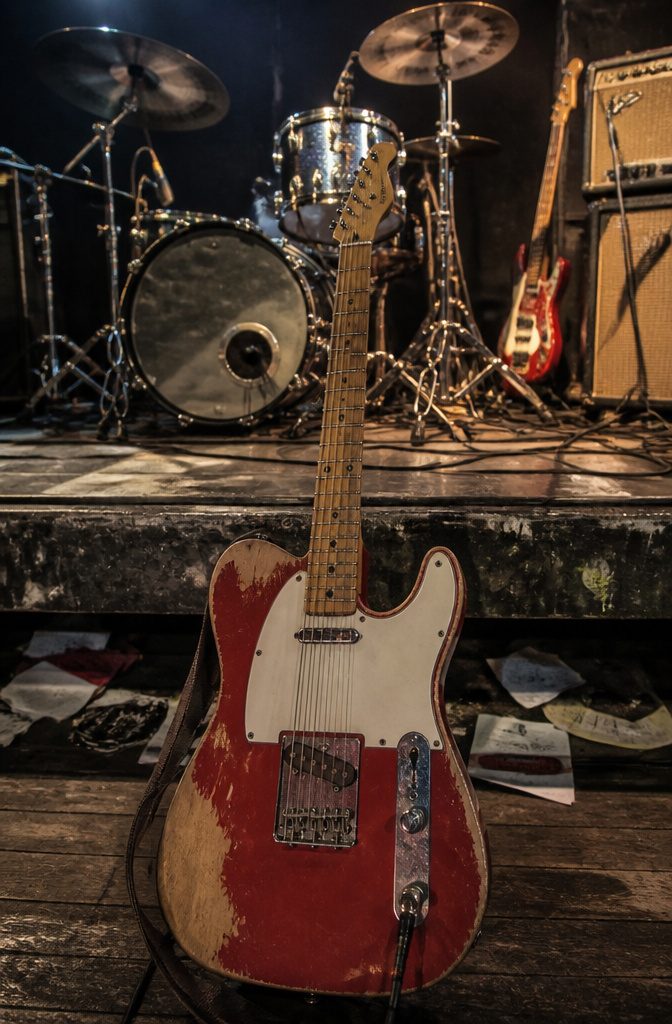
Two drummers on a single kit is the first thing that hits you when The Dirtbombs take the stage.
Mick Collins built the Detroit band around that lineup in the early 1990s, and the doubled percussion gives their records a wall of rhythm that single-drummer garage punk rarely achieves.
The bass player switches to fuzzed-out guitar on half the songs, so the sound shifts mid-set from stripped-down punk to something closer to Motown’s grittier cousins.
Collins came out of the same scene that produced the Gories, but The Dirtbombs aimed wider. They covered Phil Collins and Stevie Wonder alongside originals that sounded like they were recorded in a basement through a blown speaker.
That range is what made them bridge figures: kids who found them through 2001’s Ultraglide in Black got a soul education they did not ask for, while older fans heard the Stooges and MC5 references keeping the band tethered to Detroit garage.
The production on their records leans into the mess. Vocals sit back in the mix, guitars fight for space, and the two drummers occasionally slip a half-beat apart before locking back in.
It is not polished, and that is exactly why it works. The Dirtbombs proved garage punk rock could absorb outside influences without cleaning up its act.

Dual mode: static & strobe -- Each color has 2 modes: static lighting and strobe lighting. Choosing strobe lighting mode for Halloween. Choosing static lighting mode for Christmas. One light can used for halloween and Christmas or landscape lighting.

CONTROL MODE - Sound control/self-propelled mode is controllable, it will automatically synchronize with your music or any sound source (even your voice) to control the flashing of the lights.

Disco ball version for RGB color - 3 beam combinations (red, green, and red & green) with colorful ball light, such multi-effect combination to create a more wonderful atmosphere.
Sound and Production Styles
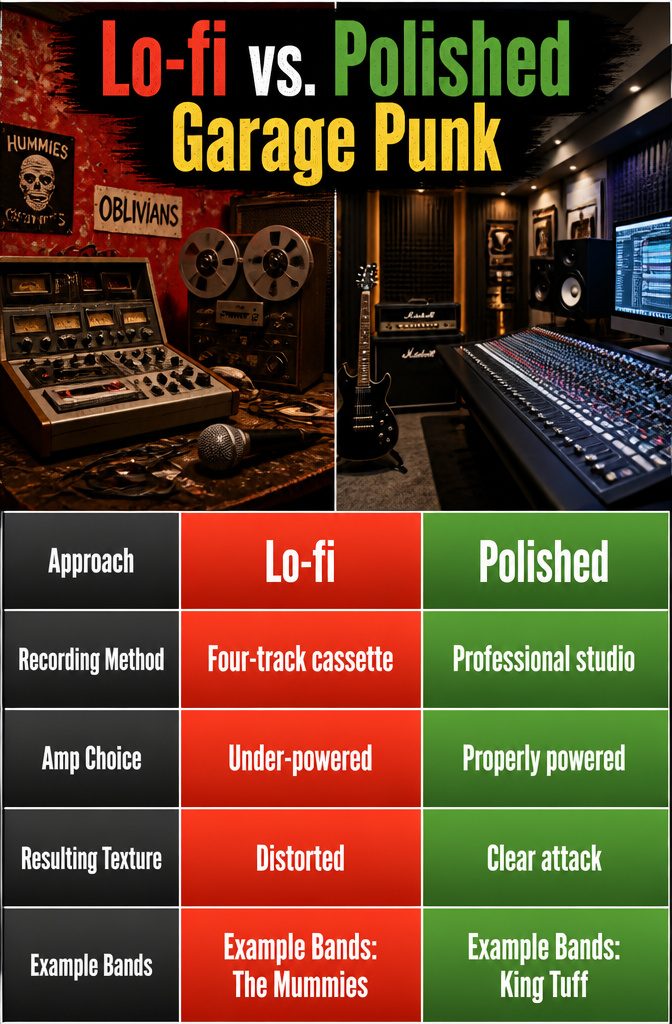
The lo-fi end of garage punk rock keeps everything in the red.
Bands like The Mummies and Oblivians tracked straight to four-track cassette or the cheapest reel-to-reel a label could rent, letting the needles slam into distortion because that was the sound, not a mistake to fix.
The Gories did much the same, often recording in borrowed spaces with mics placed wherever feedback sounded most like a threat. That crunch comes from under-powering amps and pushing cheap microphones past their limit, not from boutique pedals.
Polished garage punk exists too, just less often. King Tuff’s Was Dead from 2008 sits at the cleaner end, psychedelic enough for 1968 but mixed clear enough to live in the aughts.
The Hives and Yeah Yeah Yeahs landed major-label budgets that let them keep the aggression while the snares actually cracked instead of collapsing into static.
| Approach | Recording Method | Amp Choice | Resulting Texture | Example Bands |
|---|---|---|---|---|
| Lo-fi | Four-track cassette, cheap reel-to-reel | Under-powered, pushed to clipping | Distorted, compressed, feedback-heavy | The Mummies, Oblivians, The Gories |
| Polished | Professional studio, modern mixing | Properly powered, miked cleanly | Clear attack, defined low end | King Tuff, The Hives, Yeah Yeah Yeahs |
The split matters for anyone hunting the sound. Lo-fi rewards mistakes and refuses to fix them; polished garage punk keeps the song structures and the sneer but loses the accidental danger.

Distortion Is Therapy artwork featuring a distressed guitar effects pedal with a rebellious face, audio cables and bold punk rock lettering.
1. FROM CRUNCH TO CHAOS – ALL IN ONE PEDAL: Dial in everything from classic rock breakup to saturated, high‑gain metal mayhem. Thanks to the unique 2‑stage distortion design, this pedal delivers thicker harmonics and aggressive punch that cuts through any mix.

80 preset patches and 80 user patches, enough for creating your sound library. You can save any preferred tones by simply pressing down the SAVE button.
Lyrics and Performance Energy
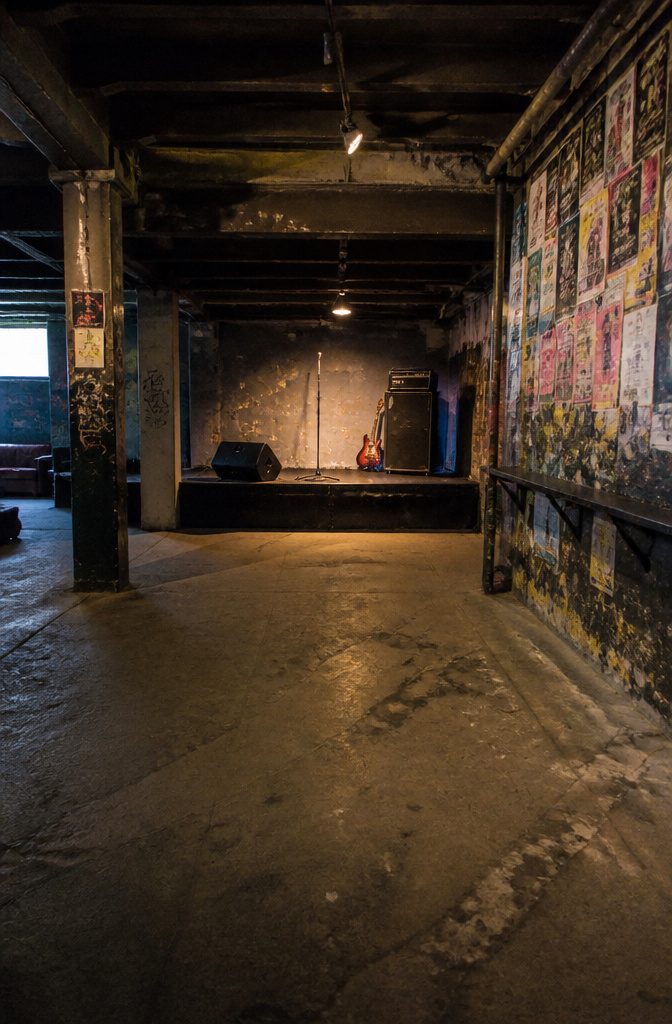
The Coathangers built their early reputation on a kind of jokiness that never softened the bite, with songs like "Nestle in My Boobies" carrying the jesters-of-riot-grrrl energy that let humor and threat share the same breath.
That mix runs through a lot of garage punk: scatological jokes, sex, drugs, partying, the whole antisocial celebration of shedding imposed rules.
But the same band turned around on Suck My Shirt and cut down "fakes, losers, abusers, wimps, chumps" with the self-assured directness of a closed fist.
The humor had not disappeared; it had hardened into something that could carry real social weight.
Live, this tension between goof and grievance is what pulls a crowd in. I have watched rooms of maybe 40 people end a set as sweat-soaked as the drummers, and the smallness of the space is the point.
You are close enough to see the singer’s spit, close enough to get knocked by a headstock.
The energy comes off as barely controlled, three people playing like they are running a marathon while singing, and the audience matches it because there is nowhere else to put your body but into it.
That is the engagement: not a stagedive or a singalong, though those happen, but the mutual recognition that everyone in the room is working just as hard as the band.

Vintage Circuit, Modern Reliability: Experience the soul of a classic 1972 British Arbiter fuzz, now refined for superior stability and ultra-low noise. Authentic tone, worry-free performance.

Premium Waza Craft Pedal: All-analog premium pedal designed to deliver the ultimate BOSS tone experience with superior craftsmanship and quality components
DIY Culture and Independent Labels
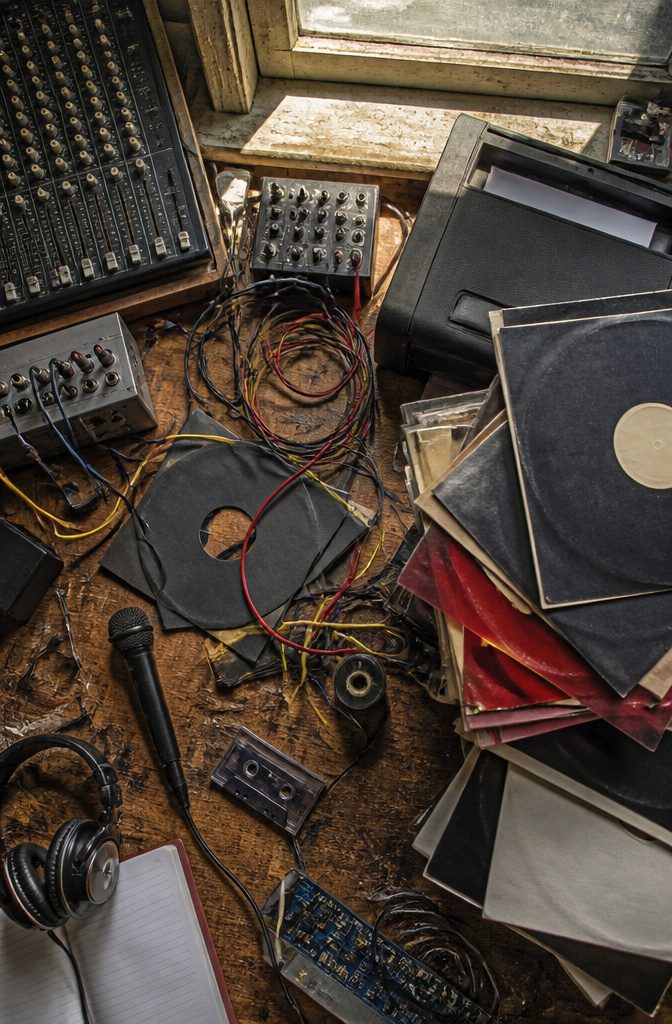
The DIY ethos wasn’t an aesthetic choice; it was the only door open. Most garage punk musicians in the early 1980s were young, white, working-class suburban kids who couldn’t get a major label callback and didn’t want one.
They recorded fast, lo-fi, and cheap on small independent labels or self-released, because that was what the budget allowed and because the sound came out meaner that way.
That independence shaped the subject matter too. Lyrics leaned into scatological humor, sex, drugs, partying, and rock and roll itself, all filtered through an antisocial stance that read less as nihilism and more as refusing imposed social rules.
The rebellion wasn’t theatrical; it was practical. You formed a band before you learned your instruments, played shows in basements, and pressed 45s in runs of a few hundred.
Independent labels did more than distribute records.
They preserved a network. Comps like Back From the Grave, Garage Punk Unknowns, and Pebbles reissued the rawest 1960s garage tracks, connecting new bands to a lineage of virtually unknown groups whose only legacy was a single or two.
Without those labels and those compilations, the sound dies with the decade that produced it.
Compilations That Preserved the Sound
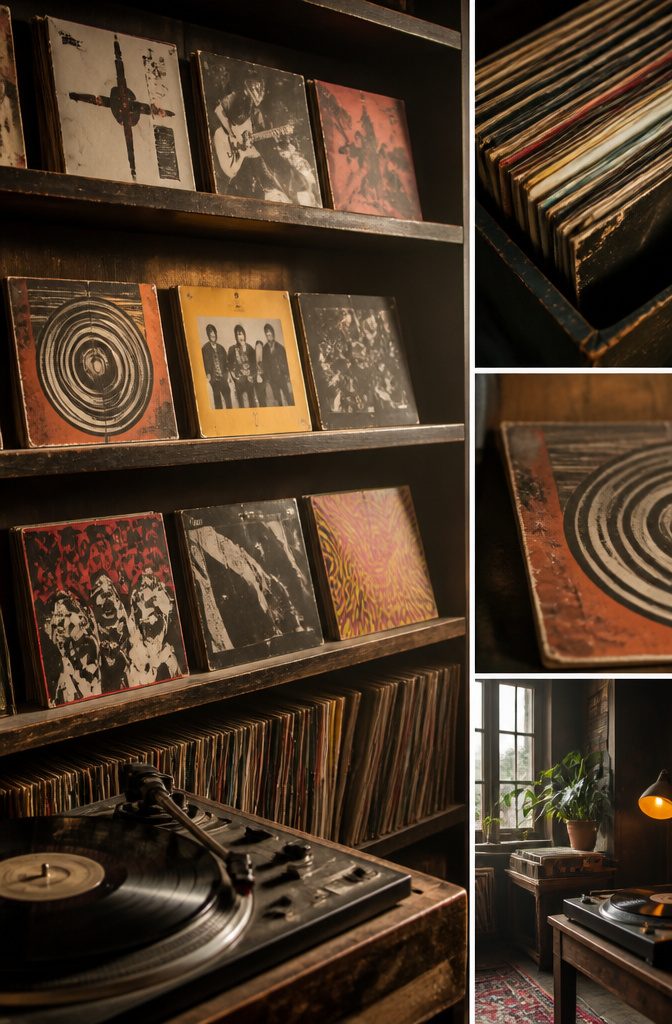
Most of the original 1960s garage singles were pressed in runs of a few hundred copies and left to rot in basements. The compilations that pulled them back into daylight shaped what garage punk rock would become.
Back From the Grave leaned hard into the rawest, most unhinged tracks, the ones where the vocals cracked and the guitars sounded like they were being punished.
That curation taught later bands that sloppiness could be a virtue if the energy held. Pebbles cast a wider net, mixing psychedelic oddities with genuine fury, and showed revivalists how much territory the sound could cover without losing its teeth.
Garage Punk Unknowns did exactly what the name promises: rescued bands so obscure that even collectors had forgotten them, proving that the defining spirit of the genre lived in anonymous kids in Ohio garages and Florida carports, not just the names that got written up.
These collections arrived on vinyl and then CD at exactly the right moment. Bands forming in the late 1980s and early 1990s could suddenly hear what 1966 actually sounded like, not a cleaned-up myth.
The compilations became the curriculum. Without them, the revival would have been guessing at its own history.
Frequently Asked Questions
What is garage punk rock?
Garage punk rock fuses the raw, unpolished energy of garage rock with the speed and aggression of punk.
The sound relies on fast tempos, lo-fi production, and sharp, brittle guitars, and it first took shape in the United States at the start of the 1980s.
Who are the notable bands in garage punk?
Notable bands include The Hives, Yeah Yeah Yeahs, Thee Milkshakes, Guitar Wolf, Mod Fun, The Gories, The Mummies, Oblivians, and The Dirtbombs. Each pushed the sound in different directions, from The Hives’ tightly wound precision to The Mummies’ deliberate self-sabotage.
What are the themes commonly found in garage punk lyrics?
Common themes include sex, drugs, partying, and scatological humor, all filtered through an antisocial stance that reads as liberation rather than simple rebellion. Some bands, like The Coathangers, later hardened that humor into direct social commentary.
Is punk music rock?
Punk is a subgenre of rock music, and garage punk rock sits at the intersection where punk’s speed and aggression meet garage rock’s raw, unpolished energy. Both share the same foundational instruments and structures, though punk deliberately strips them down.
What is horror punk rock?
Garage punk rock’s antisocial stance leans toward partying and rebellion rather than the macabre theatricality horror punk favors.
Is punk rock liberal or conservative?
Garage punk rock’s antisocial stance reads as liberation from imposed social rules rather than alignment with any political program.
The genre’s working-class roots and DIY independence shaped its attitude more than formal ideology, with lyrics focused on personal freedom rather than partisan politics.