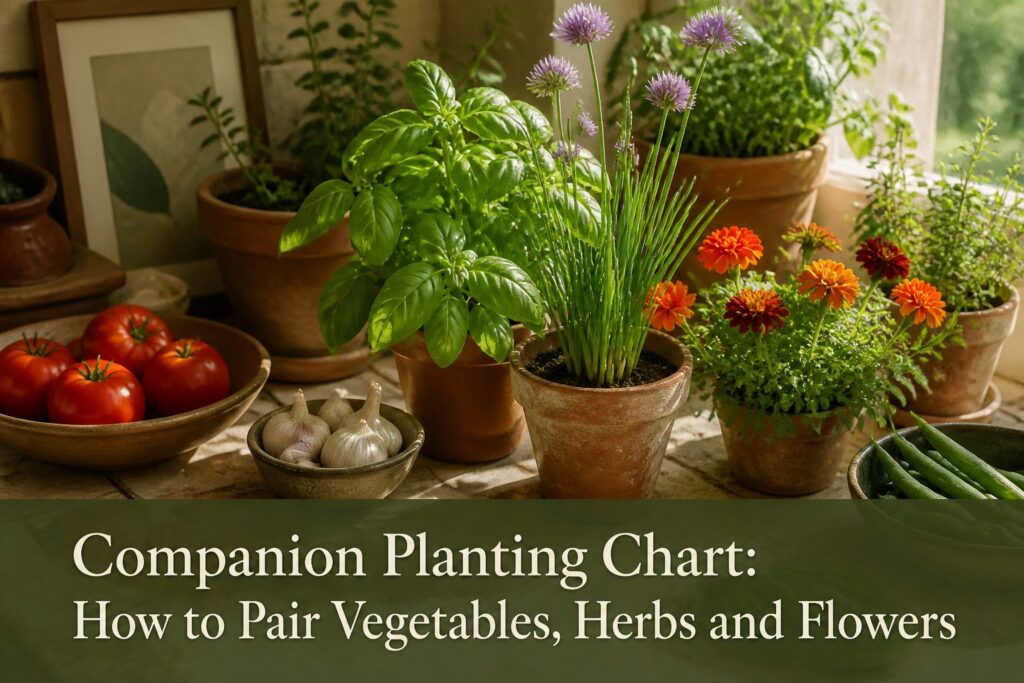
A companion planting chart shows which vegetables, herbs, and flowers grow better together and which combinations invite trouble.
The chart only works if you actually read the pest profiles and family names, not just the yes-or-no pairings: tomatoes and potatoes share blight, fennel suppresses neighbors, and beans fail outright near garlic.
Basil within two feet of tomatoes cuts aphid and hornworm pressure through volatile oils, though the flavor boost gardeners swear by has never held up in a blind test.
[link-whisper-related-posts]Tomatoes With Basil
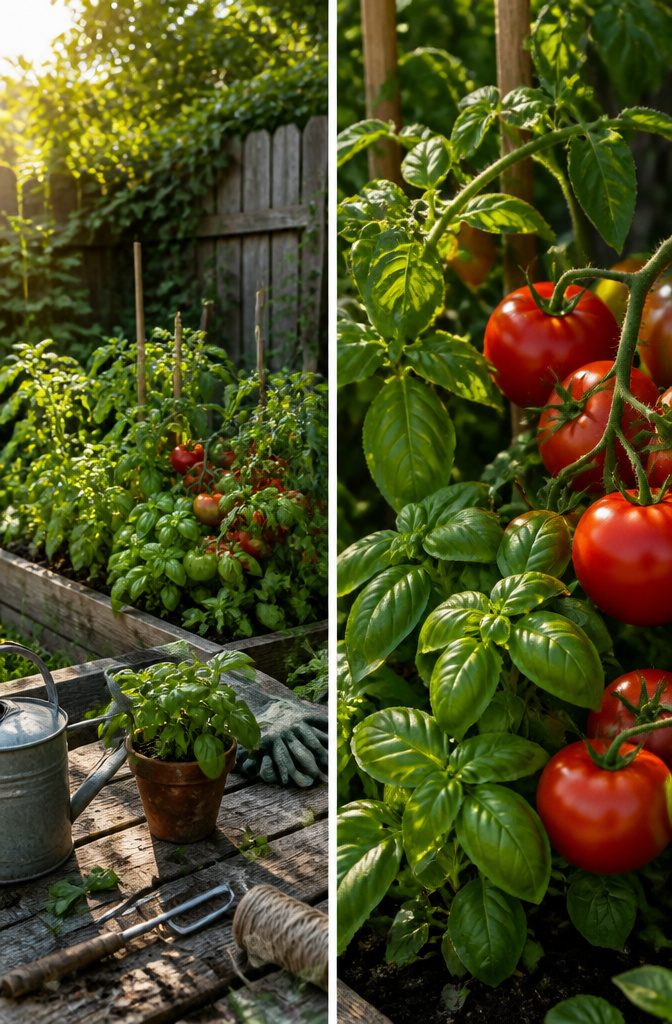
Basil’s volatile oils, the same compounds that hit you when you brush past a leaf on a hot afternoon, seem to confuse or repel aphids and tomato hornworm.
I plant them close enough to matter, usually within about two feet, and the tomatoes still get some pest pressure but nothing like the years I skipped the pairing.
The science on whether basil actually improves tomato flavor stays fuzzy; plenty of experienced gardeners swear by it, and I have noticed the plants do fine together, though I would not claim I can taste the difference in a blind test.
Tomatoes should not share space with fennel, corn, or potatoes.
Fennel releases compounds that inhibit growth in neighboring plants, corn invites the corn earworm that also targets tomatoes, and potatoes share late blight and other soil-borne troubles that transfer readily between the two nightshades.
Keep potatoes and tomatoes in separate beds, full stop.
The basil pairing works through chemical signaling rather than any structural benefit, so placement matters less than proximity; a pot of basil on the patio edge still helps if it sits downwind of the tomato row.


EASY TO USE & UNDERSTAND - Simplify your garden with our easy-to-use wheel-based vegetable garden planner! Determine seeds needed, planting depth, optimal spacing, and much more for 21 popular vegetables. The garden planner works in all regions of the USA and Canada. Simply adjust the frost line with the frost dates of your area to get started.

We have reserved a 0.6in (1.5cm) white margin for you, which is convenient for you to frame with a photo frame
Cucumbers With Nasturtiums
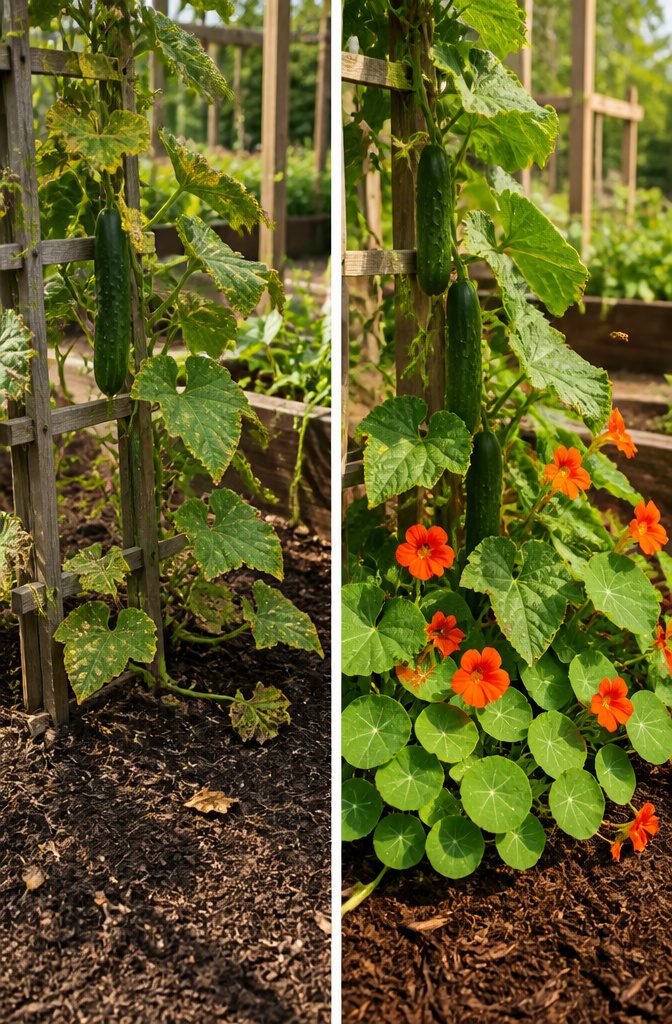
Nasturtiums work as a trap crop for aphids, drawing them away from cucumber vines so the cucumbers stay clean and productive.
The concept is straightforward: certain plants are so attractive to specific pests that the pests congregate there instead of on your crop. You sacrifice the trap plant to protect the one you want to harvest.
This is biological pest management, not chemistry. No sprays, no schedules, just planting something the bugs prefer.
Aphids will cluster on nasturtium leaves in thick colonies while the cucumber foliage nearby remains largely untouched. The nasturtiums also pull in pollinators with their bright flowers, which benefits cucumber fruit set.
I plant nasturtiums at the edge of the cucumber bed or in pockets throughout the row, not mixed right at the base where they might compete for water.
They are easy to start from seed and grow fast enough to establish before aphid pressure builds.
The trap crop works best when you check it regularly and remove heavily infested nasturtium leaves before the aphids mature and wing off to new ground. Letting the trap plant become a breeding colony defeats the purpose.

Arranging your garden with this in mind can double your bounty!

5 COMPANION PLANTS - This five-pack includes heirloom seeds for growing Large Leaf Basil (Ocimum basilicum), Borage (Borago officinalis), Compact Dill (Anethum graveolens), Crackerjack Marigold (Tagetes erecta), and Tip Top Mix Nasturtium (Tropaeolum majus)

Beans With Corn
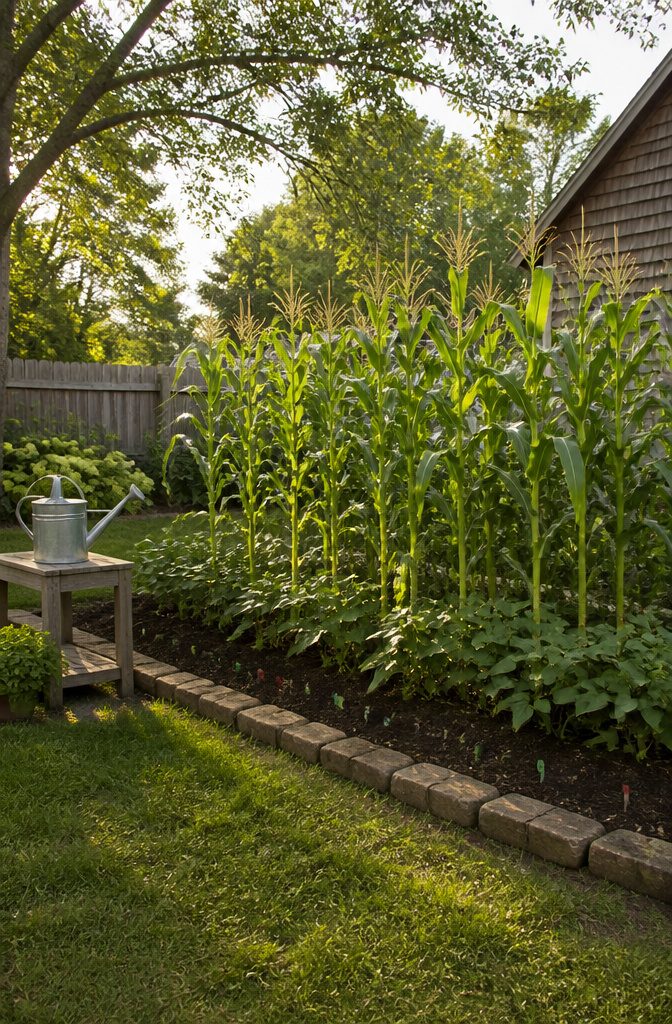
The pairing of beans with corn is one of the oldest working combinations in any companion planting chart, and it still holds up because the two plants solve completely different problems for each other.
Corn grows tall and rigid, which gives pole beans a natural trellis to climb without buying cages or stringing wire.
Beans, being legumes, pull nitrogen from the air through root nodules and leave it in the soil in a form the heavy-feeding corn can actually use.
The nitrogen fixation happens below ground while the physical support happens above it, so neither plant is competing for the same resource at the same time.
This two-way trade is the engine inside the broader Three Sisters method, where squash joins the group to shade the soil and suppress weeds.
The three together, corn, beans, and squash, were developed by Native American farmers thousands of years ago and remain one of the few companion planting strategies with solid backing from both garden experience and soil science.
Science has not confirmed every claimed benefit of companion planting overall, but the nitrogen transfer and structural support here are well documented.
For a small weekend gardener, the beans-and-corn pair is the most practical piece to borrow from the Three Sisters.
Even a short row of corn with beans at the base gets you the same mutual support in a space you can actually manage.
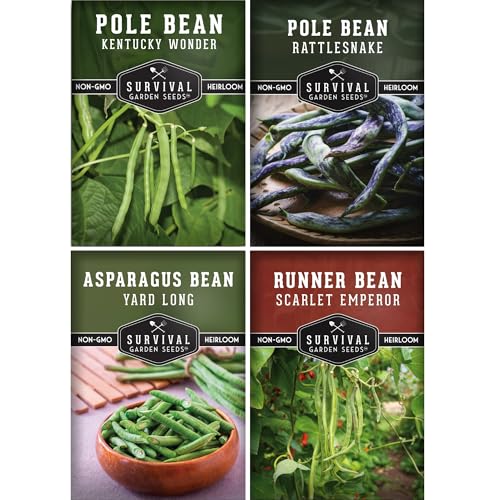
4 HEIRLOOM POLE BEANS – Kentucky Wonder & Rattlesnake (Phaseolus vulgaris), Yard Long Green (Vigna unguiculata subsp. sesquipedalis), and Scarlet Emperor (Phaseolus coccineus); a diverse mix of classic snap beans, striped pods, extra-long Asian yard beans, and bold red-flowering runner beans

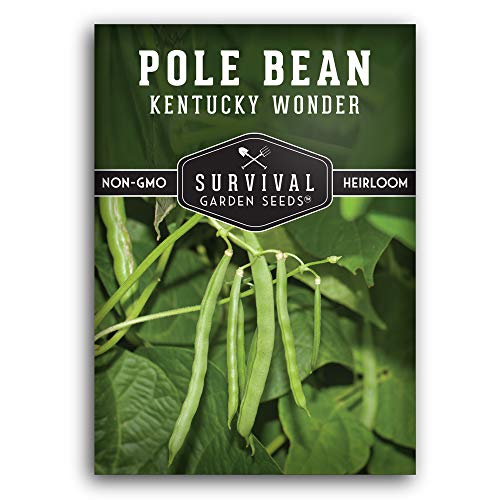
CLIMBING POLE BEANS SEEDS - Kentucky Wonder pole bean (Phaseolus vulgaris) seeds produce vigorous vines that climb trellises, fences, and poles, maximizing vertical space and increasing production in compact garden areas
Carrots With Onions
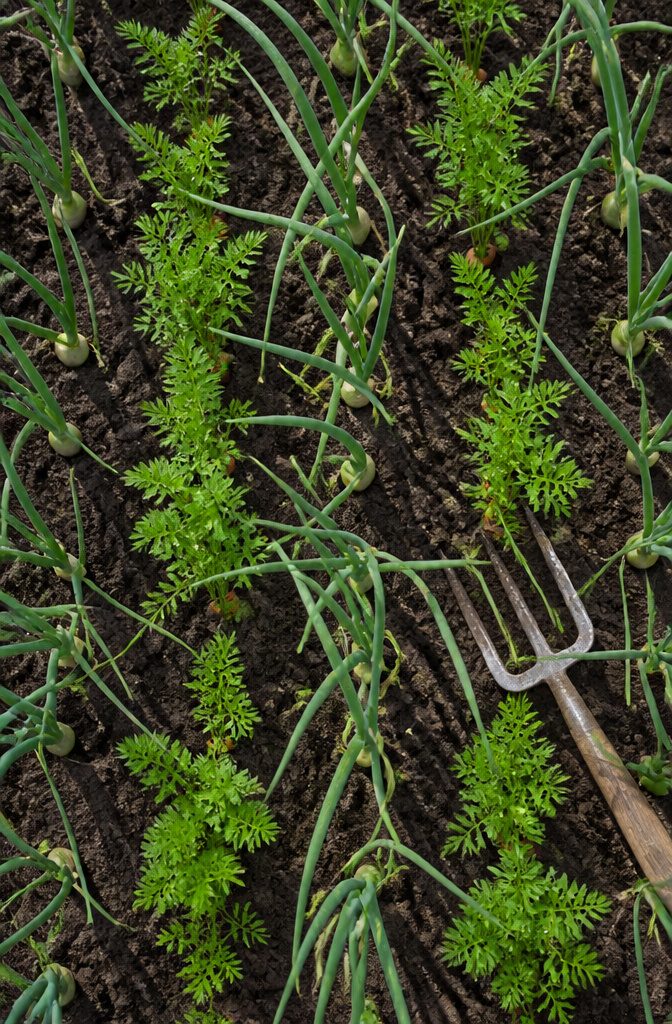
The smell of raw onion on your hands after planting is doing more work than you think.
Those sulfur compounds, the same ones that make you tear up at the cutting board, seep into the soil and confuse the carrot fly’s ability to locate your crop.
The pest relies on scent to find young carrots, and onion vapor disrupts that signal enough to send it elsewhere.
I plant these two in alternating rows, one line of carrots then one line of onions or leeks, rather than mixing them randomly through a bed.
I treat the benefit as one-directional and plan accordingly; carrots repelling onion fly in return is not well supported.
Radishes fit in the gap while you wait.
Sow them between the rows in early spring and they’ll finish before the carrot greens need the space. By the time you’re pulling the last radish, the onions are established enough to start releasing their protective chemistry in earnest.

Gardener's Companion Planting Chart Poster Collections: This gardener's companion planting chart poster collection features practical, easy-to-follow designs that simplify companion planting, helping gardeners grow healthier, more productive plants
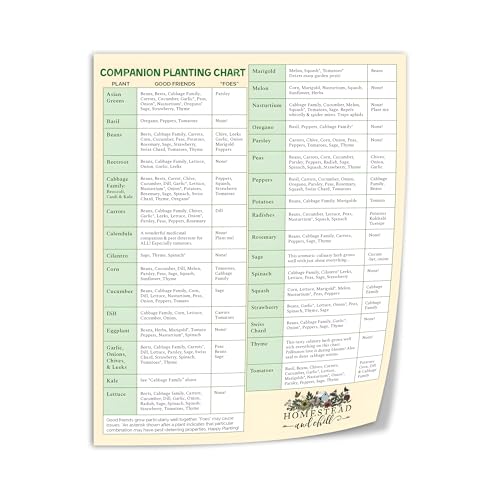
COMPREHENSIVE GUIDE: Features a detailed companion planting chart showing compatible and incompatible plant combinations for optimal garden planning and pest control

Peppers With Basil
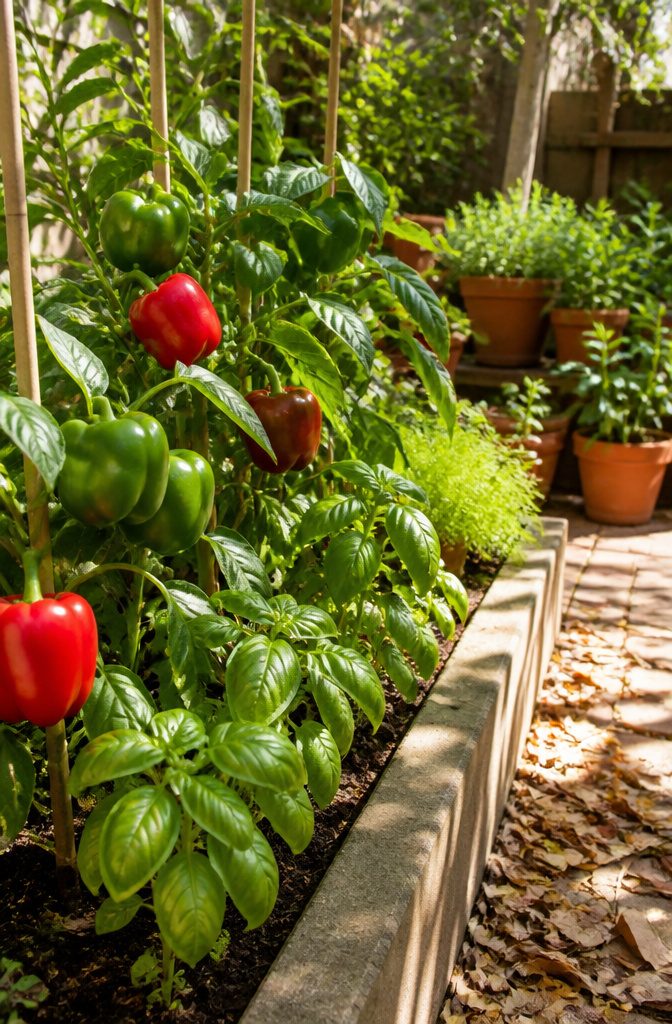
Basil planted alongside peppers confuses and repels aphids, spider mites, and thrips, the same volatile oils that make the herb worth growing in the first place.
The pairing works much like basil with tomatoes, though the pest list shifts: peppers don’t draw tomato hornworm, so that particular benefit drops out, and the flavor-boosting claim that follows tomatoes around gets less airtime with peppers.
Basil still repels flies and mosquitoes in either spot, which matters on a patio where you’re working.
Spacing ends up similar in practice, about two feet between plants, enough for air movement without isolating the root zones.
The difference worth noting is timing. Peppers sit in the ground longer than most tomatoes in many zones, so basil planted at the same time may bolt and turn woody before the pepper season closes.
A mid-season sowing of fresh basil, or a second stand tucked in as the first starts flowering, keeps the aromatic cover active when late-summer pest pressure peaks.
Fennel stays the one plant to keep clear of this pair; apricot trees too, though that’s a concern for growers in the warmer ranges where peppers overwinter.

PREMIUM HEIRLOOM SEEDS - Sourced from the USA, these non-GMO, heirloom seeds ensure robust growth, making them ideal for basil seeds for planting indoors or outdoors. Cultivate a flavorful basil plant with these premium herb seeds.


High Germination Rate: Our Genovese Basil seeds, sourced in the USA, offer a reliable option for growing fresh basil. These heirloom, non-GMO seeds typically germinate within 5 days under proper conditions, making them ideal for year-round planting.
Squash With Marigolds
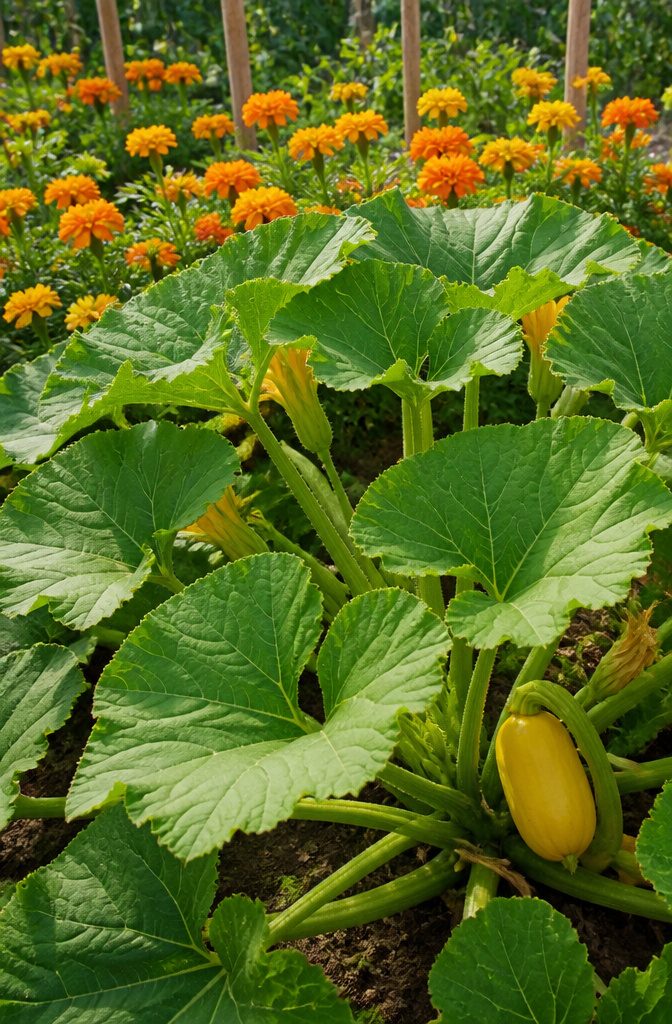
French marigolds earn their keep around squash more than almost any other pairing on a companion planting chart.
Their roots release thiophenes, compounds toxic to root-knot nematodes that otherwise spend the season silently wrecking vegetable roots underground. Above ground, the flowers deter aphids and whiteflies from settling on squash leaves.
Planting too few and spacing them too casually is the mistake that undermines this pairing. A dense border of marigolds around the entire vegetable area, not a few scattered plants, is what makes the protection real.
Numbers determine whether this works or just looks pretty. The upside is that French marigolds bloom from June straight through frost, so the border carries its weight visually even when you are not thinking about pests.

Beautiful – Large premium packet of Asparagus Yard Long Bean (Vigna sesquipedalis) seeds. These beans live up to their name, producing an abundance of crisp green pods that can reach from 1-3 feet long. Vines can reach 9-12 feet in height. Also known as Chinese long beans, long-podded cowpeas, or snake beans. Minimum of 10 g per packet (about 80 seeds).

CLIMBING POLE BEANS SEEDS - Kentucky Wonder pole bean (Phaseolus vulgaris) seeds produce vigorous vines that climb trellises, fences, and poles, maximizing vertical space and increasing production in compact garden areas

Beautiful - Large individual packets of Bantam Sweet Corn (Zea mays), Kentucky Wonder Pole Beans (Phaseolus vulgaris var. ‘Kentucky Wonder’), and Waltham Butternut Squash (Cucurbita pepo). Grow an abundant harvest in a small space.
Lettuce With Chives
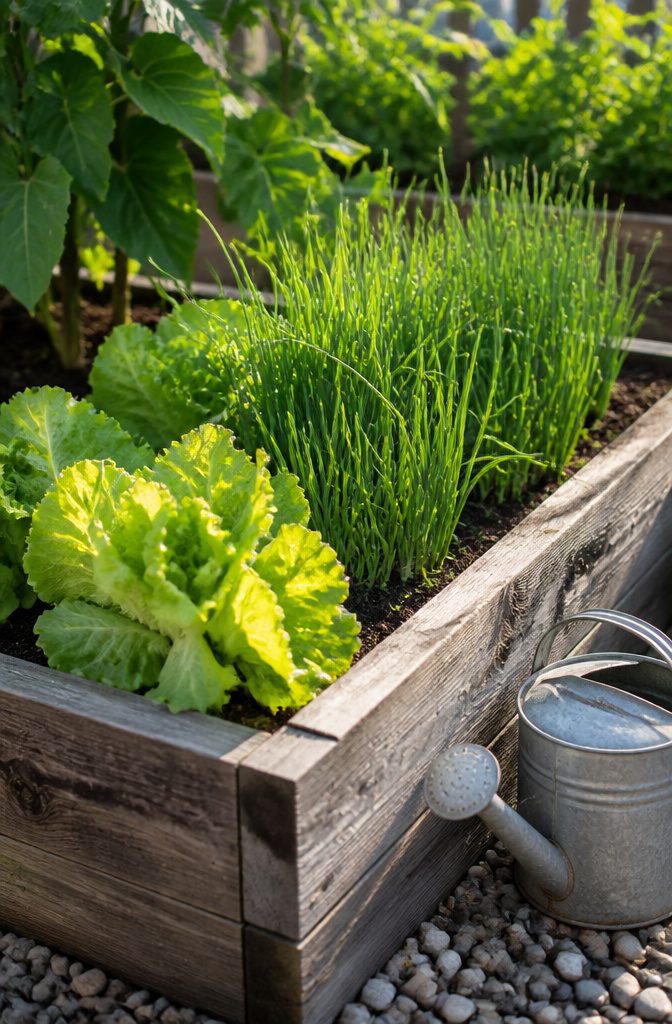
Chives release sulfur compounds through their roots and leaves that mask the scent lettuce gives off, the same scent aphids use to locate their target.
The chemical effect, called allelopathy, turns the chive into a living repellent rather than a barrier you have to reapply.
In a small bed or container where every inch competes, this pair works because the root systems occupy different depths.
Lettuce stays shallow; chives send roots deeper and grow upright in a narrow clump, so neither crowds the other for water or surface soil. A single pot on a balcony can hold both without the lettuce bolting from stress.
No significant plants need avoiding with this combination, which matters when space is tight and you cannot afford to sacrifice a corner for a bad neighbor.
I have planted them as a border edge in a square-foot grid, the chives forming a thin scented wall against whatever pests drift in from the path.
The lettuce fills the inner squares and gets the shade it wants in hotter weeks.
Chive scent deters aphids and thrips that attack lettuce, and in a container under 2 feet across, that protection travels farther than you would expect from such a small plant.

Gardener's Companion Planting Chart Poster Collections: This gardener's companion planting chart poster collection features practical, easy-to-follow designs that simplify companion planting, helping gardeners grow healthier, more productive plants

COMPREHENSIVE GUIDE: Easy-to-read chart showing compatible and incompatible plant combinations for optimal garden planning and increased harvest yields

Broccoli With Dill
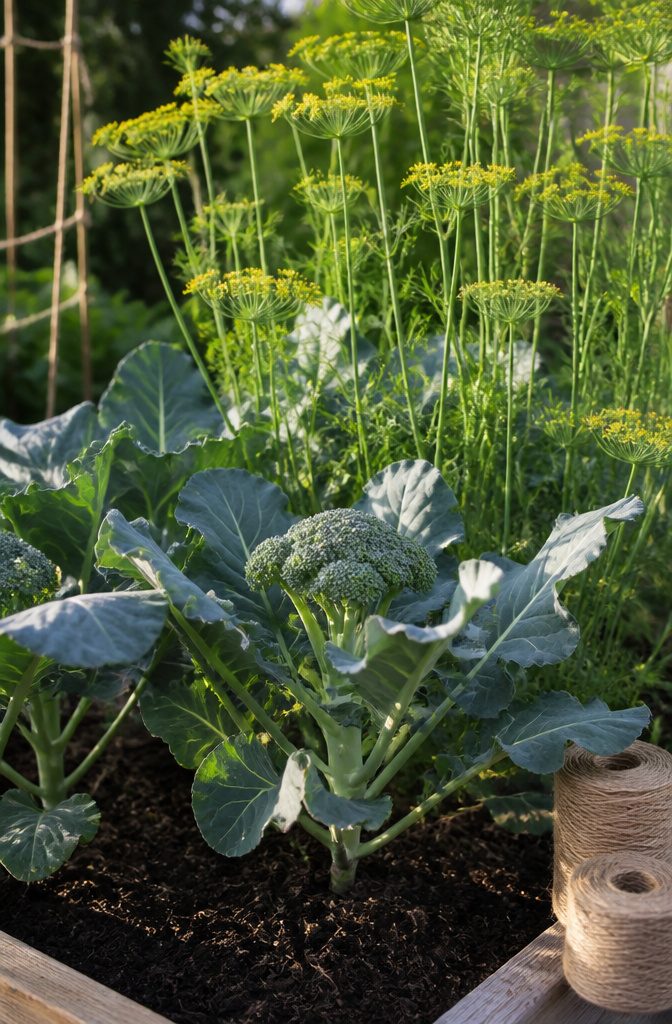
Dill brings in the wasps and hoverflies that hunt cabbage worms and aphids, the two pests that can turn a broccoli row into lace by mid-July.
The tiny flowers on a mature dill umbel are packed with nectar, so the beneficial insects stick around and patrol the bed. That makes this pairing biological pest management through predator attraction, not a scent barrier that repels bugs.
The timing needs attention. Dill bolts to 3 or 4 feet by late June in most zones, and a floppy dill plant will shade out broccoli seedlings if they go in together too early.
My approach is to start broccoli from transplants so it has some height when the dill self-sows or gets direct-seeded at the bed edge.
If you are sowing dill deliberately, plant it on the north side of the row so the broccoli still gets afternoon sun, or choose a compact variety and cut it back before it flowers if you need the leaves for pickles.
The insects arrive for the bloom, so let at least some dill go to seed.


Reliable Germination: Genovese basil seeds sprout in 5-10 days. Genovese sweet basil seeds can be started directly at 65°F soil. For early start plant 6-8 weeks before last frost 4-6 seeds per cell, sow 1/2 inch deep in moist, well-drained soil.
Radishes With Nasturtiums
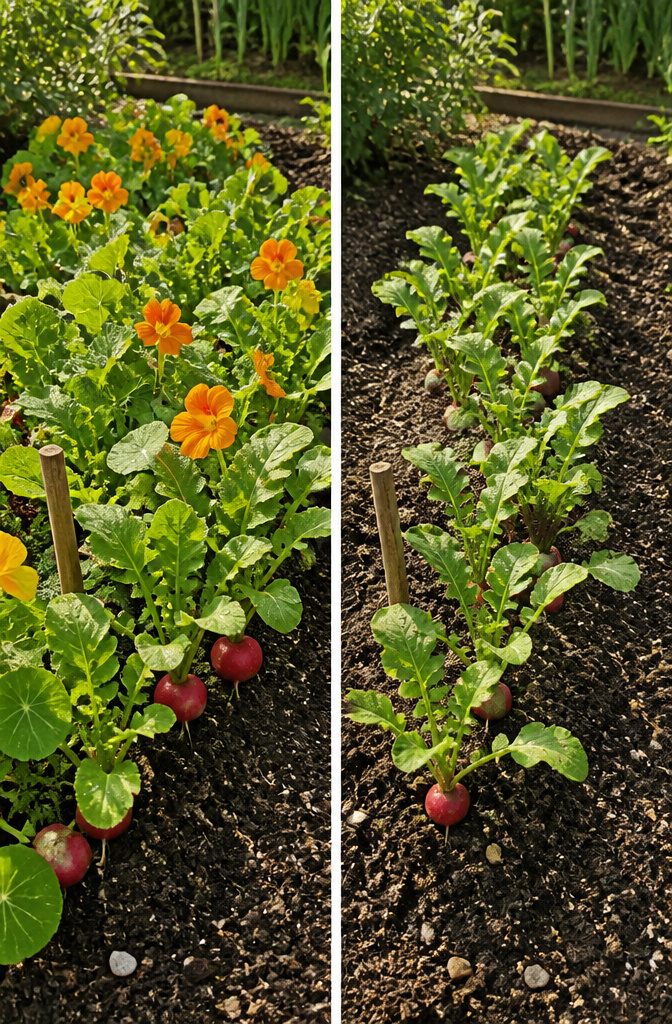
Nasturtiums pull the same trick for radishes that they do for cucumbers, but the timing changes everything.
Aphids still flock to the nasturtiums first, clustering on those round leaves like they have nowhere else to be. With cucumbers, the nasturtiums have weeks to build up that colony while the vines slowly stretch out.
Radishes race through their whole life in about a month, so the trap crop needs to be established early or it misses the window entirely.
I start nasturtiums from seed two weeks before the radishes go in, or I cheat with seedlings from the garden center.
The flowers need to be open and smelling like mustard by the time the radish greens are still tender enough to tempt a flea beetle or an aphid scout.
Radish flowers themselves will draw beneficial wasps if you let a few bolt, which is a nice backup plan, but the nasturtiums do the heavy lifting on pest diversion while the roots are still swelling underground.
The real difference is in how you manage the trap.
With cucumbers, you can let the nasturtiums ramble and they will keep producing leaves all season. With radishes, pull the nasturtiums after the radish harvest or the aphids migrate right when the next crop goes in.
I learned that the hard way one spring when I left them standing and found the aphids had moved to my lettuce seedlings by June.
Fresh Harvest: Seeds Grown in 2025 for Your 2026 Garden Season - High-Quality and Ready to Thrive - Kickstart Your Garden with the Best Seeds.

Beautiful - Large premium packet of Kentucky Wonder Pole Bean seeds (Phaseolus vulgaris var. ‘Kentucky Wonder’). Old-timey favorite snap bean introduced in 1864 in Kentucky. The 7" bean pods are stringless when harvested early and have a tender texture and reliable flavor. Great fresh, canned, or frozen. Minimum of 13g per packet (about 40 seeds).
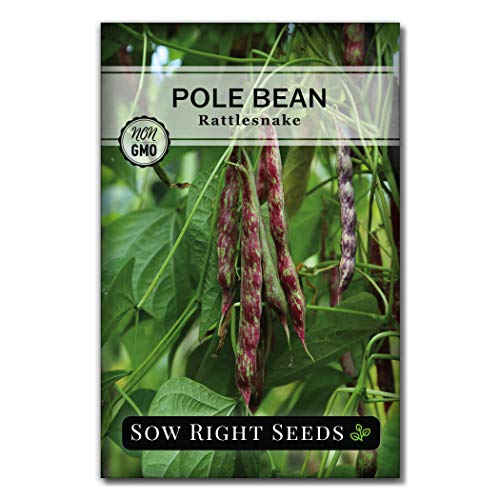
Beautiful - Large premium packet of Rattlesnake Pole Bean (Phaseolus vulgaris) seeds. These vigorous climbing beans will be a focal point in your vegetable garden with the unusual purple streaks on dark green beans. Minimum of 13g per packet (about 40 seeds).
Strawberries With Borage
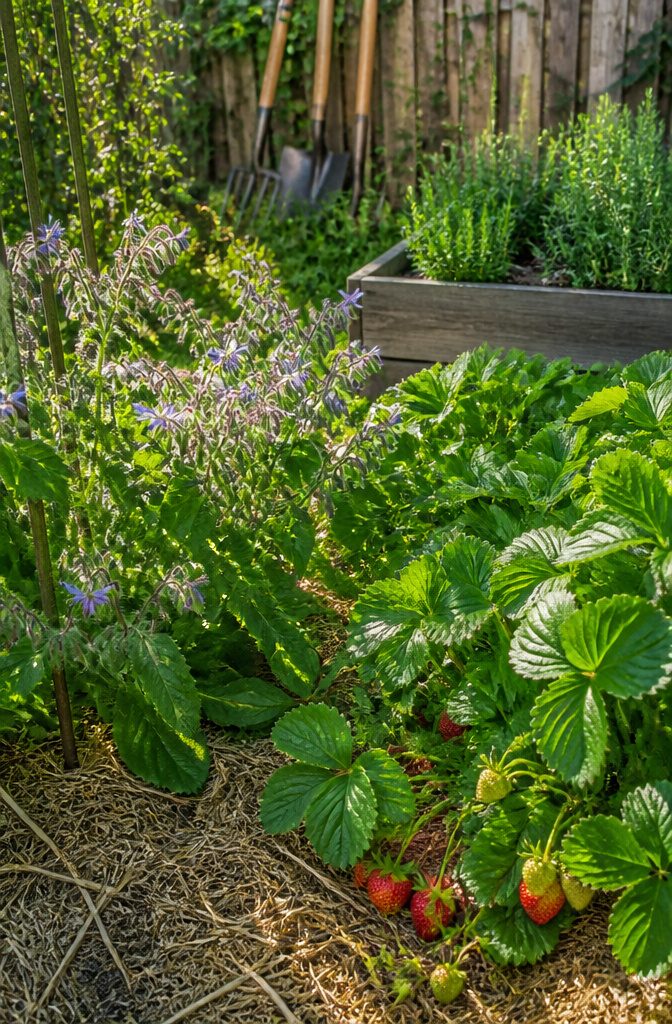
Borage planted near strawberries draws bees and other pollinators that improve fruit set.
The flowers keep coming from late spring through summer, which means coverage during the weeks when strawberry plants are setting fruit. More pollinator traffic translates to better-formed berries and higher yields, not fewer pests.
Borage reseeds freely once established, so only plant it where you are ready for it to stay. Borage self-seeds readily and spreads where it wants, so a single season’s planting can become a permanent neighbor.
That works if you have space to let it wander between rows, less so in a tidy raised bed where it crowds the edges.
Two ways to play this: treat it as a permanent bed border and thin volunteers in spring, or grow it in pots you move into place during bloom and pull before seed sets.
The pots win if you rent and the garden plot changes year to year.
Garlic With Roses
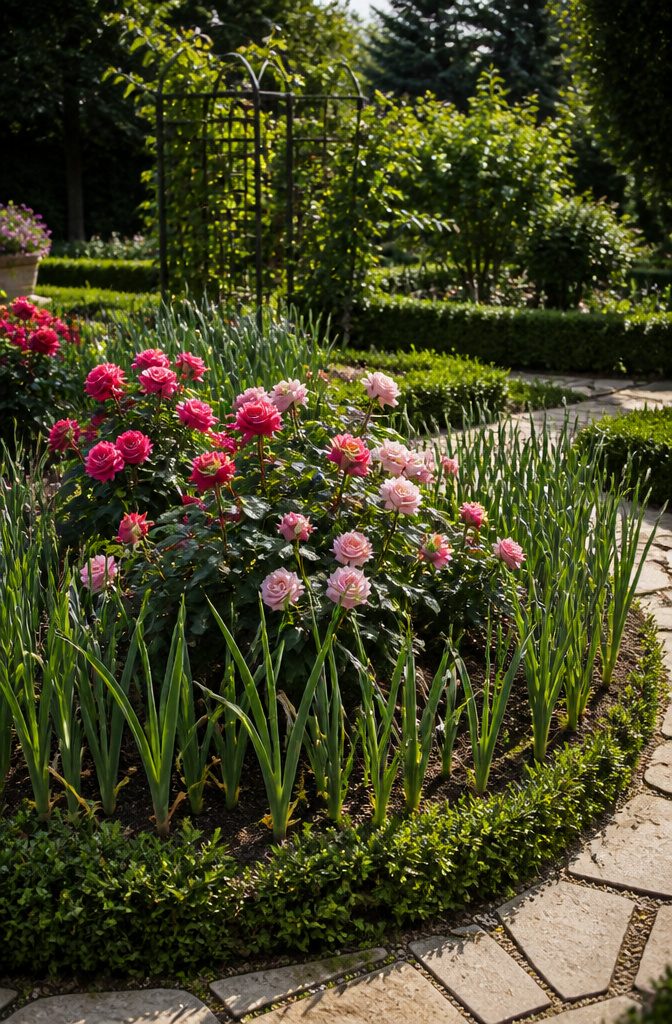
Garlic planted in a circle around rose bushes sends aphids packing before they ever settle on the new growth.
The sulfur compounds in garlic act as a broad natural repellent, and this pairing belongs on any companion planting chart that mixes ornamentals with edibles.
Roses give you flowers to cut; garlic gives you bulbs to harvest. Neither asks you to choose between a pretty yard and a practical one.
The technique is simple. Small garlic cloves tucked into the soil at the rose’s drip line, roughly a hand’s span from the stem, release those compounds through roots and leaves alike.
Garlic’s pest protection extends well beyond aphids to a wide range of insects, so the bed stays cleaner overall without spraying.
Frances Gale, who grows her own garlic, found this out by accident three years ago when she had too many small cloves and nowhere else to put them. No aphids since.
Harvest the garlic in summer when the tops yellow, then replant in fall if you want the guard duty to continue.
The roses do not mind the company, and you get a second crop from ground that would otherwise sit empty.
How Companion Planting Works
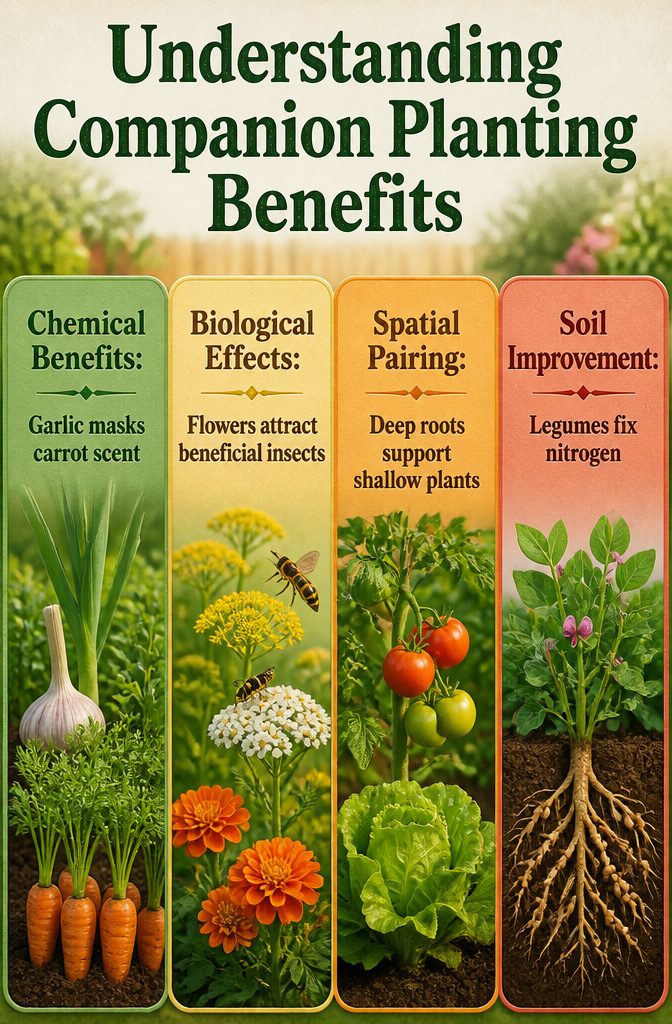
The first mechanism I noticed in my own beds was chemical.
Garlic planted near my carrots seemed to cut down on fly damage, and reading later explained why: the sulfur compounds garlic releases through its roots and leaves mask the scent that carrot flies use to find their target.
Marigolds work the same way underground, pushing thiophenes from their roots that actually kill soil nematodes before they can attack neighboring vegetables.
Biological effects showed up the season I let dill and yarrow flower instead of harvesting them.
Small, open blooms drew hoverflies and predatory wasps I would not otherwise have seen, and those insects cleared aphids off nearby crops without any intervention from me.
Nasturtiums operate on a slightly different biological principle, acting as trap crops that pull aphids away from cucumbers by being more attractive to the pest.
Spatial pairing matters more than I expected. Tomatoes and lettuce share a bed comfortably because the tomato roots run deep while lettuce stays shallow, and the tomato’s height filters light the lettuce can still use.
The classic Three Sisters grouping takes this further: corn gives beans something to climb, beans fix nitrogen the corn needs, and squash leaves shade out weeds that would compete with both.
Soil improvement through nitrogen fixation is the slowest mechanism to observe, but the most reliable. Legumes pull nitrogen from the air and deposit it through their roots, which neighboring heavy feeders access once the legume dies back or gets cut.
Deep-rooted companions also break up compaction and draw minerals from subsoil layers that shallower plants never reach.
What Not to Plant Together
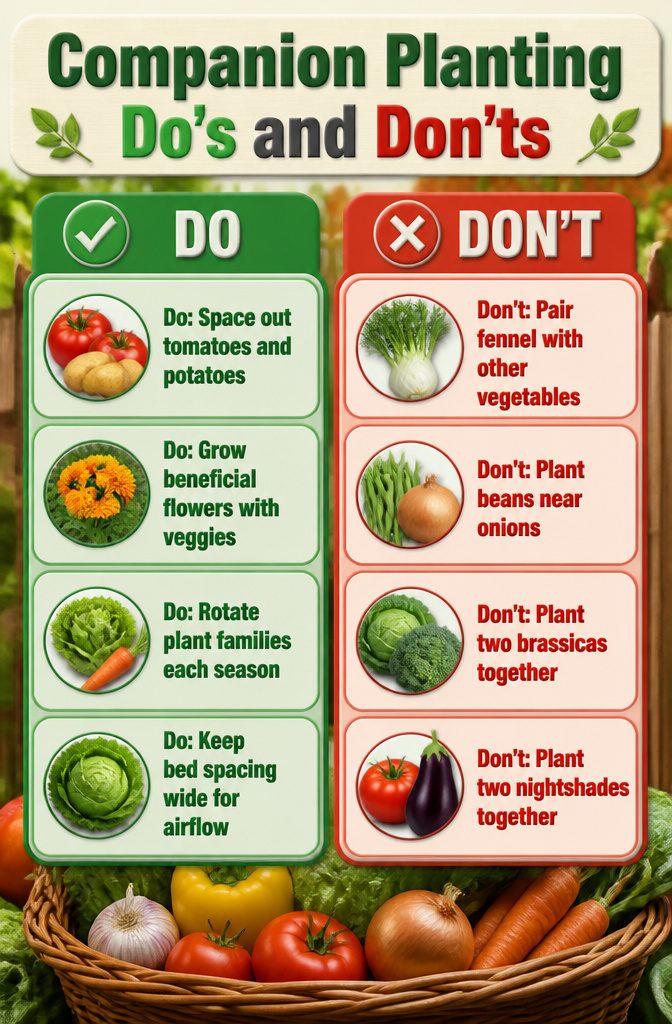
Tomatoes and potatoes share more than the nightshade family name. They share early blight and late blight, so planting them side by side gives disease a straight path to travel between crops.
I learned this the hard way the season I squeezed a few potato hills against my tomato row to save space; both beds went down by August.
Fennel is just as risky, releasing allelopathic compounds that suppress growth in most vegetables. It needs its own corner, far from the main beds.
Beans with onions or garlic is another pairing that looks efficient on paper and fails in practice. Those alliums actively inhibit bean and pea growth, so opposite ends of the garden is the only layout that works.
The broader rule behind these specific mismatches is crowding plants from the same family or with the same pest profile.
Two brassicas together, two nightshades together, any combination that blocks airflow or doubles as a magnet for the same insect, turns a companion planting chart from a guide into a liability.
Space and rotation still matter; the chart only works when you read the spacing and the family names, not just the yes-or-no pairing.
The Three Sisters Method
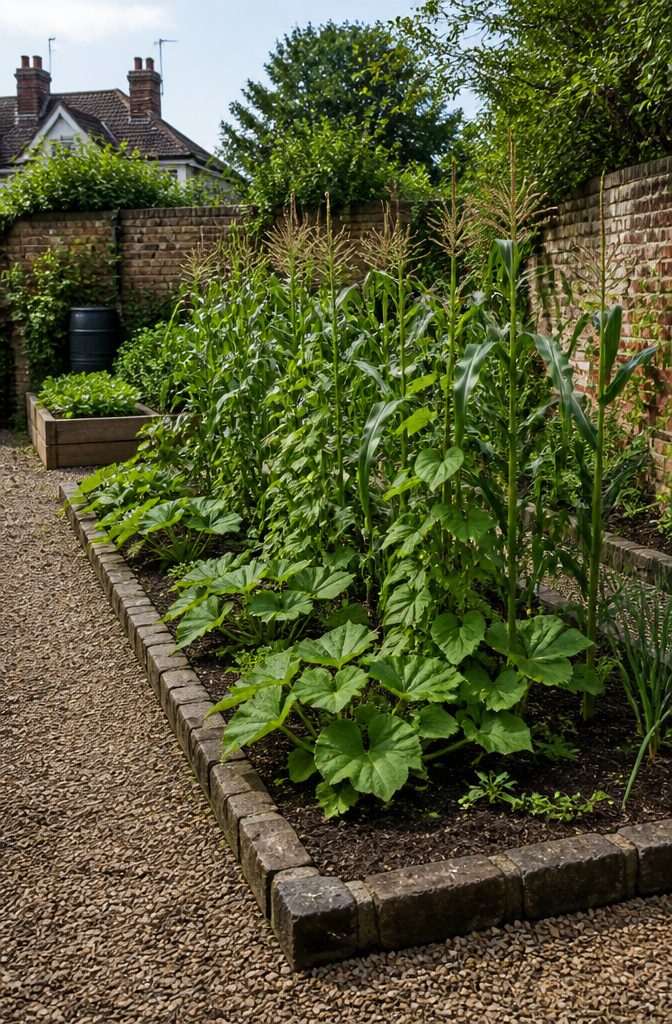
The Three Sisters method is the clearest picture of what a companion planting chart is trying to teach: one pairing can do several jobs at once.
Corn grows tall and gives pole beans something to climb. Those beans pull nitrogen from the air and feed it into the soil, which supports the heavy-feeding corn and the sprawling squash.
The squash leaves shade the ground, keeping moisture in and weeds down, and their prickly texture can discourage raccoons.
This system scales down better than most people assume. A 4 by 4 foot bed can hold a tight version: four corn stalks in a small block, beans planted to climb them, and one squash plant at the edge to spill outward.
The traditional spacing is generous, but the relationships stay intact even when the footprint shrinks.
Two practical notes from gardeners who have tried it. First, the beans need a head start on the corn, or the corn outpaces them and the beans never catch the stalks.
Second, not every squash behaves the same: zucchini stays more compact than pumpkin, which makes it easier to manage in a small plot where a vine running ten feet turns from ground cover into obstacle.
Frequently Asked Questions
What is companion planting?
Companion planting is the practice of growing certain plants near each other so they help one another through pest deterrence, nutrient sharing, soil improvement, or attracting beneficial insects.
Some pairings are one-sided, like flowers drawing pollinators to vegetables, while others trade benefits both ways.
The classic Three Sisters grouping of corn, beans, and squash is an example of mutual support: corn gives beans a trellis, beans fix nitrogen for the soil, and squash shades out weeds.
What should you not plant next to tomatoes?
Do not plant tomatoes near fennel, corn, or potatoes. Fennel releases growth-suppressing compounds into the soil around it.
Corn invites the corn earworm, which also attacks tomatoes. Potatoes share late blight and other soil-borne diseases with tomatoes, so keep these two nightshades in separate beds.
Do marigolds really keep pests away?
Yes, but only if you plant enough of them.
French marigold roots release thiophenes that kill root-knot nematodes in the soil, and their flowers deter aphids and whiteflies above ground. A dense border around the vegetable area works; a few scattered plants do not.
Which vegetables grow well together chart?
This companion planting chart shows pairings that work: tomatoes with basil, cucumbers with nasturtiums, beans with corn, carrots with onions, peppers with basil, squash with marigolds, lettuce with chives, broccoli with dill, radishes with nasturtiums, strawberries with borage, and garlic with roses.
Each pairing solves a specific problem through scent confusion, trap cropping, nitrogen fixation, predator attraction, or spatial stacking.
What plants should be planted next to each other?
Plant basil near tomatoes or peppers to repel aphids and other pests through volatile oils.
Pair beans with corn so the beans climb the stalks while fixing nitrogen the corn needs. Set nasturtiums beside cucumbers or radishes as a trap crop for aphids.
Plant onions or chives near carrots or lettuce to mask the scent pests use to find those crops. Marigolds belong in dense borders around squash to suppress nematodes and flying insects.
What vegetables should never be planted next to each other?
Keep tomatoes and potatoes apart since they share blight and other diseases. Do not plant fennel near most vegetables; its allelopathic compounds inhibit their growth.
Separate beans from onions and garlic, which actively suppress legume growth. Avoid clustering plants from the same family or with the same pest profile, as this concentrates risk instead of spreading it.
What plants need to be planted in pairs?
No plants strictly require a partner, but some pairings deliver clear benefits worth planning around. Beans and corn need each other less than they simply solve different problems for each other: corn provides structure, beans provide nitrogen.
Basil near tomatoes or peppers repels pests that attack both. The trap crop pairings like nasturtiums with cucumbers or radishes only work if the trap plant is present and established before pest pressure builds.